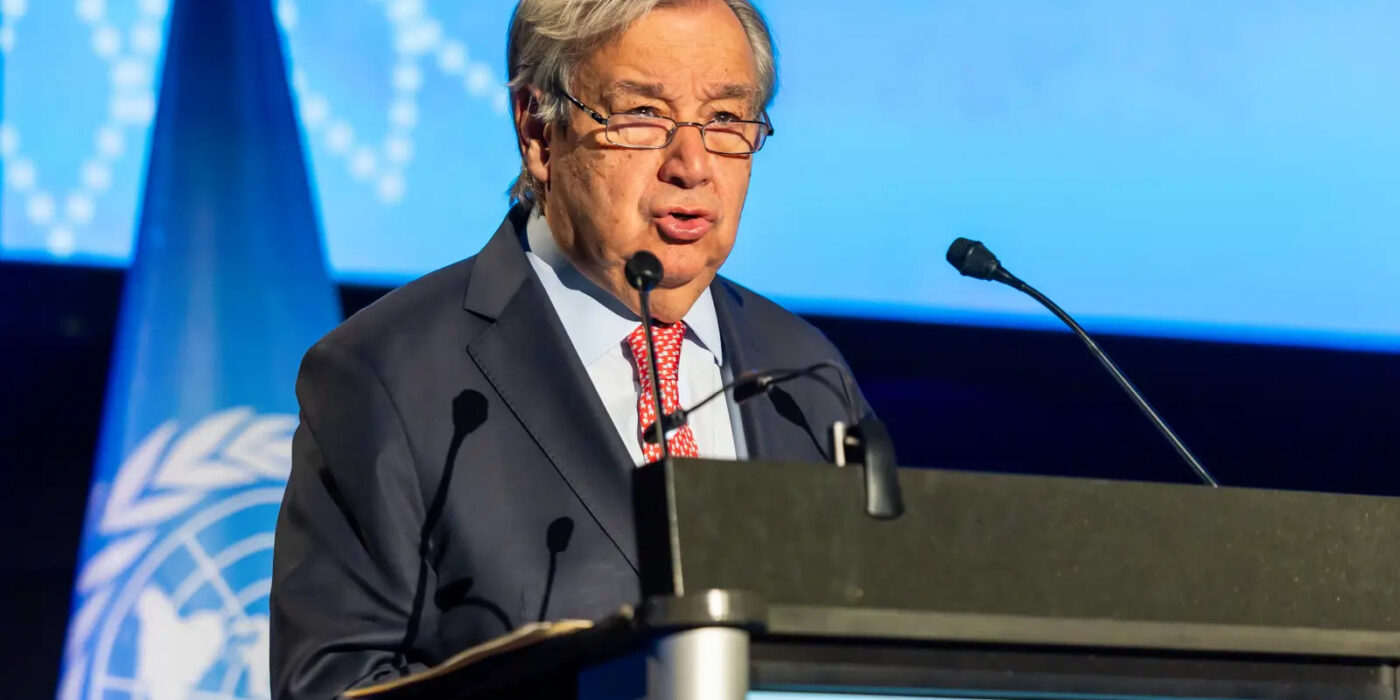
Antonio Guterres opened the UN’s first Global Dialogue on AI Governance this week with a warning that the world is running an experiment on itself without a plan or consent, and a set of proposals that are far more specific than the soundbite that made the headlines. A closer look at what he said, and where Pakistan could fit into it.
When Antonio Guterres stood up in Geneva on Monday to open the UN’s first Global Dialogue on AI Governance, the line that traveled around the world within hours was the one about vibe-coding: that using AI to describe what you want instead of writing the logic yourself can do wonders for a piece of software, but it cannot be how humanity decides its own future. It is a clean, quotable metaphor, and it is easy to see why every wire service led with it.
But treating that line as the whole story misses most of what the speech was actually arguing, and it misses the parts that matter most to a country like Pakistan, which is neither one of the handful of nations building the frontier models nor a bystander to what happens once they are built.
Guterres’s underlying argument was less about coding and more about control. He argued that AI systems are no longer passive tools waiting for instructions. They are already writing code, acting online with growing autonomy, and making decisions with steadily less human oversight, while the institutions meant to govern technology were built for an earlier era.
The choice facing every government, in his framing, is between governing AI by deliberate design or drifting into whatever future the technology and a handful of companies happen to produce by default.
What the Speech Actually Proposed
Underneath the metaphor, the speech contained proposals considerably more concrete than most coverage suggested:
- A Global Fund for AI: Guterres said he intends to push the General Assembly to create a fund aimed at building skills, data infrastructure, and affordable computing power in countries that currently have very little of any of the three.
- An AI Child Safety Pledge: A call for common international methods to evaluate and verify AI risk, comparable to testing regimes for medicines and children’s toys, requiring companies to prove systems reachable by children are safe and can route distressed children toward real human support.
- A ban on lethal autonomous weapons: A renewed call to outlaw systems that select and engage a target without a human in the loop.
- Environmental disclosure: Pressure on AI companies to disclose the environmental footprint of their data centres and commit to renewable power by 2030.
Woven through all of it was a warning that the concentration of AI development in a small number of companies and countries is itself one of the central risks the world now faces, and that most nations have had no meaningful input into decisions that will shape their own futures. Left unaddressed, that imbalance risks hardening the existing digital divide into something closer to a permanent AI divide.
Where Pakistan Could Actually Fit Into This
None of this is settled policy. These proposals were introduced in an opening speech at the start of an ongoing dialogue, and each one still has to survive contact with the General Assembly, with the handful of governments and companies that hold most of the leverage over how AI actually gets built, and with the far slower machinery of international agreement in general.
But several of these proposals line up closely with gaps Pakistan’s own startup ecosystem has been describing for a while now, mostly to each other rather than to anyone in a position to act on it.
The Compute Gap
The infrastructure shortage a Global Fund for AI is meant to address is not abstract here. Access to affordable compute remains one of the biggest constraints Pakistani AI founders point to when discussing what holds their companies back. Local teams rely heavily on overseas cloud providers for AI workloads, while universities and research labs compete for limited shared compute resources.
If a fund like this gets real backing at the General Assembly rather than staying a line in a speech, it becomes one of the few realistic channels through which that constraint could loosen. The practical question is whether local founders and policymakers are positioning themselves to draw from it early, rather than watching countries that engaged early secure the funding first.
Child Safety in EdTech
The child safety proposal lands in a similarly specific place. Pakistan already has a growing number of edtech startups building AI tutoring tools for a very young population, often faster than any regulator here has had the capacity to review. An international benchmark would give founders already building this responsibly something concrete to work toward, rather than each company inventing its own standard alone.
A Seat at the Table
There’s also a broader opening in the governance gap itself. Guterres was blunt that most countries have had no real input into how AI is being governed so far. Seen as an invitation rather than an indictment, a first dialogue of this kind is exactly the point in a process where a country with Pakistan’s demographics and pace of digital adoption can start showing up with an actual voice, instead of waiting for rules finished elsewhere.
The Real Takeaway
Guterres has no enforcement power over any government, and whether these proposals become reality depends largely on decisions made in Washington, Beijing, and inside the handful of AI labs leading frontier development.
For Pakistan, the more useful takeaway is less about whether Guterres succeeds and more about timing: the fund does not exist yet, the standards have not been written, and the pledge has not been signed by anyone. That is precisely the stage where founders, regulators, and investors still have a chance to shape these mechanisms instead of simply adopting rules designed elsewhere.
Guterres closed by saying this may be the last generation able to set the terms on which humanity and machines coexist, and that the door is still open but won’t stay open long. The question is whether Pakistan walks through it before someone else writes the rules.
Sources: Dawn, Manila Times, Kuwait Times, The Star (reporting via AFP)