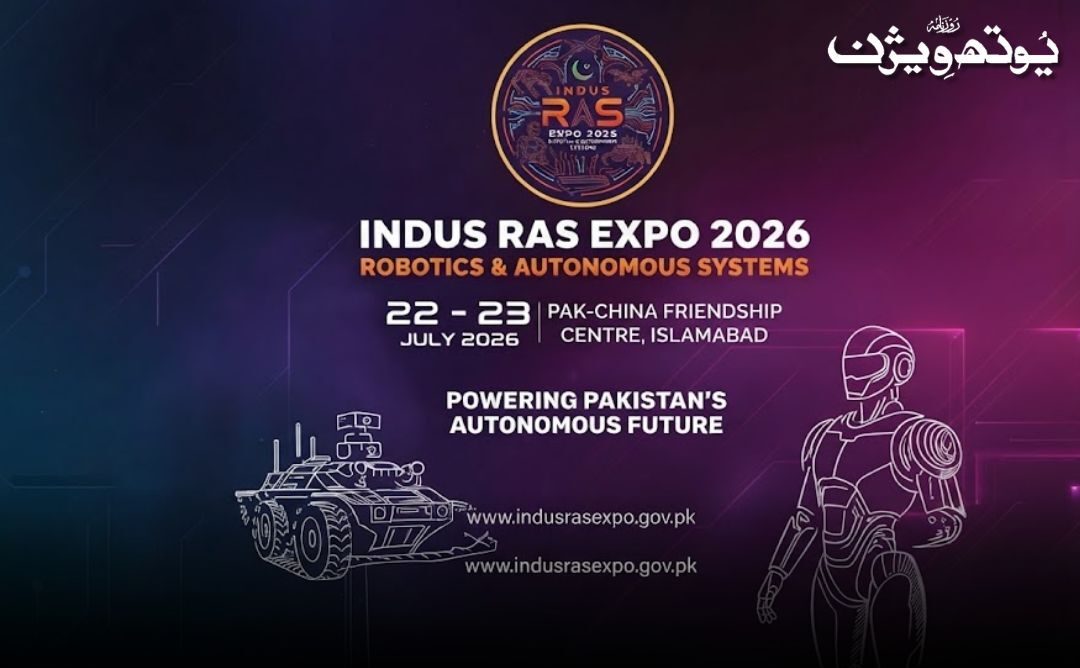
On 22 and 23 July, the Pakistan-China Friendship Center in Islamabad hosted something the country hasn’t officially had before: a national platform built entirely around robotics and autonomous systems. The Indus RAS Expo 2026, organized by the Ministry of IT & Telecommunication with Ignite and the National Center of Robotics and Automation (NCRA), brought together a Prime Minister’s endorsement, aerospace veterans, AI executives, and a room full of students building robots with their own hands. Strip away the drone shows and the RoboWar battles, and what’s left is a statement of intent about where Pakistan wants to place itself in a technology race it has largely watched from the sidelines.
The Gap It’s Trying to Close
Pakistan has talked about digital transformation for years, mostly in the language of IT exports and software services. Indus RAS Expo is a deliberate pivot toward something harder: physical technology robotics, drones, autonomous maritime systems, industrial automation, agritech. These are capital-intensive, infrastructure-heavy fields that most emerging economies enter late, if at all, because they require manufacturing capacity, defence-adjacent R&D, and long investment horizons that don’t pay off in a single budget cycle.
That’s precisely why the expo’s own framing, “strengthen indigenous capability,” “position Pakistan globally” — carries more weight than typical conference language. It’s an admission that the country has largely been a consumer of robotics and autonomous technology, not a producer, and an attempt to change that by giving the ecosystem a visible, government-backed rallying point. Having the Prime Minister headline it, rather than a ministry official, signals this isn’t meant to be filed away as a niche tech event it’s being positioned as national industrial strategy.
Why Defence and Maritime Are on the Same Agenda as Startups
One of the more telling choices is what’s grouped under the expo’s “focus areas”: defence robotics sits alongside agritech, industrial automation next to physical AI, maritime autonomous systems beside startups and innovation. In most countries these live in separate ecosystems defence R&D is classified and slow-moving, agritech is commercial and iterative, startups are scrappy and fast. Putting them under one roof suggests an attempt to break down the silos that usually keep military-grade robotics research from ever touching commercial innovation, and vice versa. Whether that cross-pollination actually happens is a different question — but naming it as an intent is itself notable, because it implies Pakistan is trying to build a domestic robotics base broad enough to serve both state and market needs, rather than importing solutions for each separately.
The Youth Bet
If there’s a throughline across both days of programming, it’s youth. Panels titled “Little Minds, Big Ideas,” “From Classroom to Innovation,” and “Beyond the Horizon: Youth Leading the Tech Revolution” aren’t incidental additions — they’re a significant share of the agenda. The speaker list backs this up: alongside CEOs and professors are students from Headstart School and Beaconhouse International College, and “young scientists” from LearnOBots, several of whom are still in secondary school.
This isn’t just optics. A national robotics strategy lives or dies on whether there’s a talent pipeline behind it, and Pakistan’s demographic reality — a very young population — makes youth engagement less a feel-good gesture and more a structural necessity. The RoboWars Championship and Student Innovation Challenge, both carrying prize money, function as recruitment mechanisms as much as competitions: they’re designed to identify and reward the students who might become the engineers and founders this ecosystem needs a decade from now.
What “Success” Would Actually Look Like
The expo’s own list of expected outcomes is worth taking seriously as a scorecard, not just a mission statement: increased adoption of RAS technologies, stronger collaboration among stakeholders, more opportunities for startups, deeper STEM engagement among youth, strengthened national capability, and recognition of Pakistan as a regional RAS hub.
Most of these are hard to verify in the near term — “strengthened national capability” isn’t something a two-day expo produces on its own. What events like this actually do, when they work, is create the conditions for capability to build over years: introducing founders to policymakers who can unblock regulation, giving academics like NUST’s robotics faculty a public platform alongside industry CEOs, and putting drone technology and autonomous systems research in front of a Pakistani audience that may not otherwise encounter it outside specialist circles. The panel on policy frameworks for robotics and autonomous systems, held on day one, may end up mattering more than the drone show — regulation, or the lack of it, is usually the actual bottleneck between “impressive demo” and “functioning industry.”
The Bigger Picture
Framed generously, Indus RAS Expo 2026 is Pakistan trying to do early — and publicly — what countries like the UAE and India have been doing for several years: treating robotics and autonomous systems as a named national priority rather than a subset of general “IT” policy. Framed skeptically, it’s one expo, and expos are easy to hold and hard to follow through on; the real test isn’t the two days at the Pakistan-China Friendship Center, but whether the policy panel’s recommendations survive contact with ministries, whether the startups that exhibited get funded, and whether the students competing in RoboWars are still in robotics five years from now.
What the expo does establish, at minimum, is a marker — a first attempt at a shared national identity for this sector, with a name, a venue, and a Prime Minister’s backing attached to it. Whether it becomes an annual fixture or a one-off will likely be the clearest signal of how seriously the intent behind it is meant to be taken.
Source: indusrasexpo.gov.pk