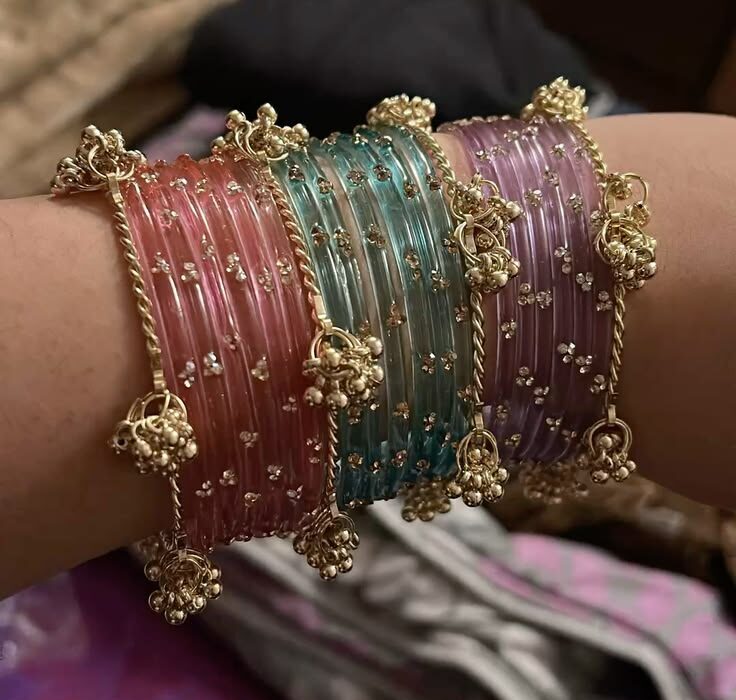
A viral accessory, a cultural moment, and the real cost of trend-driven buying.
Kashmiri chooriyan stacked golden bangles adorned with tiny ghungroos have become the most searched and sold festive accessory in Pakistan ahead of Eid ul-Fitr 2026, driven almost entirely by viral Instagram and TikTok reels. Selling at Rs 1,500 per set in peak-season markets, they are as overpriced as they are everywhere. Here’s why that’s the whole point.
Key Numbers:
- Selling price in Pakistani markets: Rs 1,500 per set (peak Eid pricing)
- Local bazaar price off-season: Rs 250–500 per set
- Price markup driven by virality: estimated 3–5x
- Trend ignition: early March 2026, 2–3 weeks before Eid ul-Fitr
What Are Kashmiri Chooriyan?
Kashmiri chooriyan are stacked bangle sets typically 4, 6, or 8 golden bracelets adorned with tiny ghungroos (small bells) layered with soft pastel “raindrop” glass bangles. Many sets feature silk thread wrapping, gota work, or pearl embellishments. They are affordable to produce, deeply photogenic, and engineered by accident for short-form video: they look beautiful and they sound even better.
How a Few Reels Created a National Shortage
The mechanics are textbook. Starting in early March 2026, a cluster of reels began circulating women pairing stacked bangles with Eid outfits, wrists lifted to the camera, ghungroos catching the light. Simple format. Clean aesthetics. Irresistible sound design. The algorithm did the rest.
Within two weeks, it had emptied shelves across Pakistan and Kashmir. Zahoor Ahmad, who runs the Bahurani jewellery shop in Sopore, told Kashmir Convener: “The demand just exploded in the last two weeks. The scale of the trend this year is unexpected.” What surprised retailers even more was the buyer demographic men. Boys were lining up to buy sets as Eid gifts for their partners, sisters, and mothers, embedding the trend into the season’s emotional language almost overnight.
Why Eid Made This Trend Unstoppable
Kashmiri chooriyan didn’t go viral in a vacuum they went viral during Ramadan, days before Eid. For Muslim women across Pakistan and the South Asian diaspora, bangles are not merely decorative. They are festive ritual. Eid is a full sensory experience the smell of sewaiyan, the colour of mehndi, the feel of new clothes and the sound of chooriyan has always been part of that texture.
This trend landed precisely where religious tradition and social media virality intersect. It made the bangles feel both culturally earned and digitally discovered a rare combination that transformed a fashion moment into a near-universal Eid purchase.
How Gen Z Is Reclaiming Culture Through Consumption
Gen Z is often accused of being disconnected from heritage. Kashmiri chooriyan complicate that narrative. This generation isn’t passively inheriting culture they’re actively curating it. They scroll, discover, purchase, wear, and in doing so, breathe new life into craft traditions that might otherwise fade quietly.
The ghungroo bangle didn’t need a museum exhibition or a government preservation scheme to find its 2026 audience. It needed the right reel. Cultural continuity, for this generation, doesn’t look like a classroom lesson it looks like a TikTok save and a next-day delivery. That’s not shallow. That’s just how culture travels now.
The “Kashmiri” Label: Cultural Resonance Over Cultural Accuracy
Here’s the uncomfortable truth: these bangles are not traditionally Kashmiri. Kashmiri brides wear gold not stacked glass bangles. The Valley’s genuine heritage jewellery includes the Dejhoor, the iconic hexagonal earrings of Kashmiri Pandit women, which look nothing like what is going viral.
The bangles being sold as “Kashmiri” are largely mass-produced. Their label was born not from origin but from a viral moment where someone used the word and it stuck. “Kashmiri” works as a brand because it carries weight artisanship, elegance, a romanticised heritage that the subcontinent has always projected onto the Valley. It is cultural resonance over cultural accuracy, and the market has leaned in completely.
The Revenue Story and the Real Cost of Trend Tax
Now for the part nobody puts in their reel.
These bangles are selling for Rs 1,500 a set. The same product or something nearly identical was available in local bazaars for Rs 250 to Rs 500 just weeks ago. The glass hasn’t changed. The metal hasn’t changed. What changed is the reel count.
This is what economists might call a demand shock, but what it actually feels like is something more human: the quiet suspension of common sense that happens when a trend takes over. When every second post on your feed features these bangles, when your friend group is already wearing them, when Eid feels incomplete without them Rs 1,500 stops feeling like a transaction. It starts feeling like belonging.
That emotional markup the price of not missing out is the most expensive thing about Kashmiri chooriyan, and it is entirely invisible. Vendors didn’t manufacture scarcity. The internet manufactured desire, and sellers simply met it at a price the moment could bear.
The question worth sitting with: would you pay Rs 1,500 for these bangles on a random Tuesday in July? Almost certainly not. So what are you actually buying this Eid? The bangles or the feeling of being part of something?